As I walked out one morning,
all in the soft fine rain,
it seemed as though a silver veil
was shining over hill and vale,
as though some lovely long-lost spell
had made all new again.And through that shimmer in the air
I seemed to hear a sound,
as though a distant horn were blown
in some lost land that I had known,
that seemed to speak from tree and stone
and echo all around.And with the music came these words:
“Poet, take up the tale!
Take up the tale this land still keeps,
in earth and water magic sleeps,
the dryad sighs, the naiad weeps,
but you can lift the veil.…
And even I, in these dark days,
have heard and found it true.
So I have taken up the tale
and passed it on to you.
I first heard of Malcolm Guite on the Literary Life Podcast a couple of months ago. I’d missed it the first time I listened, for I thought he was speaking of a poem on Galahad and the Grail. As I started searching for this fabled poem, I found it was a book that he had written. Better yet, this book was written in an epic poem style and part of a greater series. As I am on a quest to find and read the great epics, I knew I must get this one. I’ve been devouring almost any interview I’ve found with Malcolm Guite, such as these here and here. Guite has a way of speaking that makes you want to hear more. Like in his introduction to Galahad and the Grail, it’s as if he’s speaking with the voices of centuries past, a voice perhaps you heard as a child in the fairytales you or your parents read, a voice that calls through every inch of history that surrounds us if we would just listen, a voice we need today. His style is melodic and engaging, and you’ll scarcely want to put this book down.
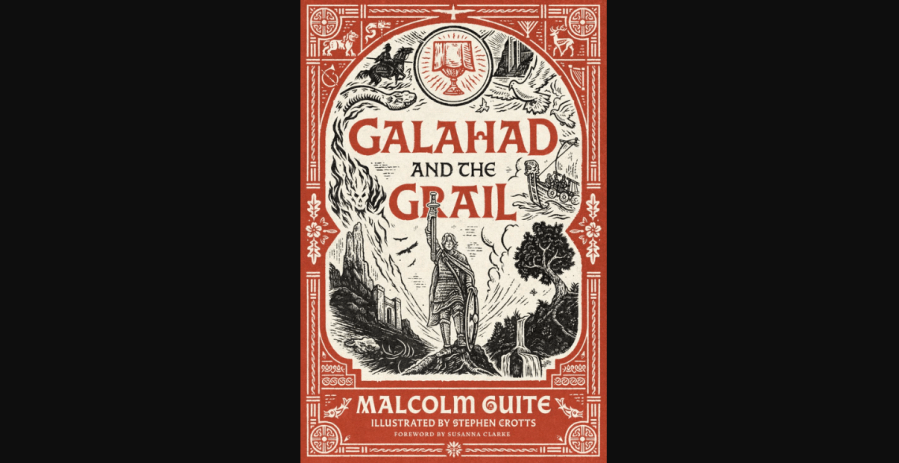
Galahad and the Grail is an epic poem worthy of the name. It is worth listening to the audiobook while you read the physical book; this allows you to appreciate the poem as all poems should be appreciated, as spoken, and to enjoy the illustrations (they are something between stained glass and woodblock prints). The book is broken into five parts: the prologue; three books entitled “The Coming of Galahad”, “Adventures of the Quest”, and “The Achievement of the Grail”; and then closing with an epilogue. There is also a foreword and appendices, which I also encourage you to read. Within each section are several staves, or individual poems, that tell this great story. You’ll meet many familiar figures from Arthurian Legends and perhaps meet some you’ve never known before. But by the end, you’ll have a better understanding and love of this deeply Christian story that every heart should know, a tale we all get to experience perhaps as we always should have because this poet listened and took up the tale.
As the poet suggested, I read this book to my children. Poetry is meant to be read out loud, not silently. Not only do you get to hear the frequent play-on-words utilized by the poet, but you get to hear the poem as it was always meant to sound: as something songlike. As Galahad and the Grail is written in a ballad poetic structure, this is even more true. I saw some parents concerned their children would not enjoy such a book. I disagree. Not only do I disagree because my own children and friends’ children enjoyed the tale, but we sell children short. They love poetry and rhyme and song. Most children’s books are written in simple rhymes, but this, this is a fairytale, a quest, a poem that will enliven their minds with story in verse. This will be one they will ask for again, and so will you.
I will admit, my Arthuriana knowledge is sorely lacking. I read a version of the stories as a child, but I couldn’t tell you what version it was. I’ve watched adaptations and recently read series like The Pendragon Cycle; I’ve tried to dig up what history is relevant. I even recently read a children’s version to my children. The draw towards the Arthurian legends really was ignited for me after reading That Hideous Strength. But I don’t think you need to know every detail to appreciate this book, although the LLP episode will help with some background to the lore. But this tale is enough on its own. Step into it with a wealth of knowledge or on the same footing as your children and grow into the story. I guarantee you’ll pick up new things with every reading.
Along those lines, something you’ll pick up with each reading is the Christian imagery. Until recently, I was unaware of how much Arthurian legends are Christian, I am sad to say. But this book paints that picture clearly and beautifully, not only in word but also in art. Artist Stephen Crotts illustrated several pieces for this book, and they capture the heart of the tale as much as the text does. While I think listening to the poem on, say, Libby is a fantastic idea, don’t neglect to get the physical book to get the full experience of sound, text, and art. You won’t be disappointed.
I find it difficult to convey my full appreciation of the text. You really must read it. While so much of the poem was “fun” to read, as I love a good questing story; parts even drew me back to my recent read, Dracula, especially with the four knights and a lady on a quest. But it was so much more than that. The poem was also beautiful and touching. The images, symbols, and historic connections were so well crafted, and certain holy scenes brought tears to my eyes. Reading the last book, I often thought how much Tolkien would have loved this. The last stave of book three and the epilogue were particularly touching. You couldn’t help but long for Sunday morning; you couldn’t help but long for Heaven. The description of the Eucharist, of the Holy Mass where heaven meets earth, I’ve rarely read anything so beautiful; I know I will return to it over and over again.
Malcolm Guite and Stephen Crotts have created true art with this book. Yes indeed, the book itself is a piece of art. The cover, the crafting, the text, the illustrations–altogether these make up what is Galahad and the Grail. Honestly, even the paper itself was a joy to touch. But the story, the poem, is enchanting. You will be swept away while you read, and so will your listeners. Do not rush it when you read — and yes, let your voice convey it. Savor every stave, treasure every tale within the tale. Take joy in what the poet has given to you. Yes, dear reader: take up the tale.
Blessings to you and yours,
~Madelyn Rose Craig

