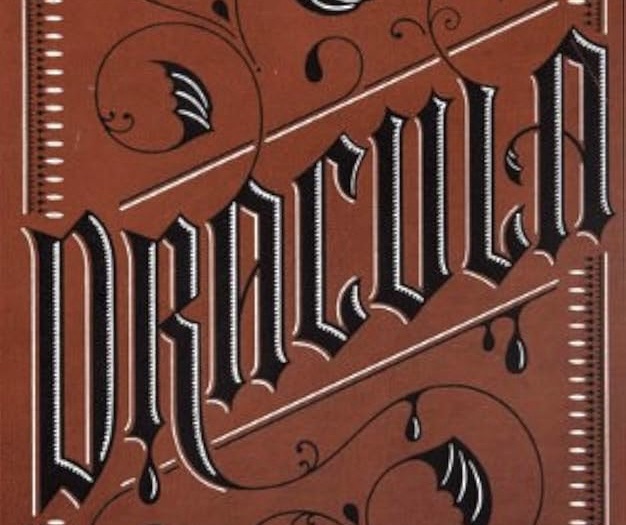
And yet, unless my senses deceive me, the old centuries had, and have, powers of their own which mere “modernity” cannot kill.
Dracula has never been on my list of books that I wanted to read. I knew of it, knew it was considered a classic, but I simply had no desire to read it. The closest I’ve gotten to enjoying a “similar” Gothic novel is with Frankenstein. But, as a Millennial who grew up in the age of misunderstood, sparkly vampires and high school werewolves, I wasn’t really interested in paranormal fantasy. And yet, a pastor friend of mine told me that Dracula was his favorite novel, and my husband told me that it was a fantastic book. So, as I was between books, I saw it on the shelf and knew I finally had to read it. I was far from disappointed. And as I never intended to read such a novel, I never intended to write such a “review!” So bear with me as I attempt to convey all this novel meant to me and why I think it is a novel everyone should read.
Dracula I think will be one of those books we call timeless. It definitely shows characteristics of its time, but it’s frame as a quest with deeply symbolic elements that weave I tot he narrative itself will keep it on the shelf as a timeless classic that will engage and inspire for times to come. Stoker’s narrative style will pull you along page after page. I could barely put the book down, even when I was sick and probably should have been sleeping. He is a master storyteller, and his flare for the dramtic and perfect pacing is evident. I believe he worked in theater, and that served him well in this book.
Dracula was everything and nothing like I expected. Yes, it is a novel about Dracula, the Vampire, and there is a group of people that hunt him down in order to save a woman. But this story is so much more than that. That is only the basic outline of this story. Dracula is as much a Medieval Romance as it is a Victorian Gothic novel, set as an epistolary narrative to guide the reader through the quest.
So how else is this book not just another vampire slayer story? First of all, this is the vampire story. Stoker is probably the only reason we care about these stories today. But where modern books keep the gist of the narrative and some of the symbols, Stoker understands the true nature of things. This is not a vampire with a tragic backstory nor are these people with superstitions in the modern sense. This is a culture in conflict, a world thinking itself enligtened and advanced and very modern. They have science, the typewriter, trains that run on time! They have guns and phonographs. Who cares for holy days and holy ground and the battle of good and evil? But as the fabled Van Helsing reminds his younger friend,
“You are a clever man, friend John. You reason well, and your wit is bold, but you are too prejudiced. You do not let your eyes see nor your ears hear, and that which is outside your daily life is not of account to you. Do you not think that there are things which you cannot understand, and yet which are, that some people see things that others cannot?“
Dracula is a story of life and death, of truth and falsehood, of modernity and the past, of flesh and spirit.
There is such rich symbolism in this story, and I wish I could share it all without spoiling the story. Not to mention that I know that with subsequent readings, I will catch even more depth of meaning hidden in these pages. When you read this novel, pay attention to dates, locations, and names. Nothing is accidental. From the start on St. George’s day to the end on All Saints. From the wedding date of Lucy (of the west!!) to the day when one brave man dies. Notice the importance placed on the modern world and the slow acceptance of the spiritual. See how there are four knights (well, three and the american knight: a cowboy) devoted to a lady and their wizard leader (yes, I’m assigning Van Helsing to the role of wise sage bridging the old world to the new). There are the hounds of hell, the three weird sisters, and so much more. The novel also touches on what makes men and women bad—such as the unwomen who consume children and unmen who care only for their appetites—and what makes them good—the mother and helpmate and the protector and lover.
Yes, the symbolism and imagery are there for those with eyes to see, who know that this world is not just of flesh and blood but of the spiritaul forces, both good and evil. Dracula knows them and uses them to his advantage. But eventually so do our heroes, with their (our) ultimate protection being found in none other than in the Body of Christ (although, I do have some qualms with some of that usage. Still, I remember this is a fairytale, not a playbook).
I loved this story because it was an old, true form of story for the modern world. This is “the 19th century!” one character reminds another. But this story doesn’t stay there. No, these timeless romances and fairytales have something to offer us even today. For this story is one from of old, of that ancient dragon that must be slain by the righteous one for the sake of another, even though he himself be slain. These are stories that know you need both sword and spirit to slay the evil one and deliver others from eternal death to eternal life. This story shows that no matter how much progress we make, no matter how great our degrees are, or our titles claim, or our power grows, the spiritual forces are always there. There is a saying that goes like this:
One of the artifices of Satan is, to induce men to believe that he does not exist: another, perhaps equally fatal, is to make them fancy that he is obliged to stand quietly by, and not to meddle with them, if they get into true silence.
Such is true for the modern world in this story. They don’t even recognize the signs of evil itself until it stares them in the face, and even then they need help. So Van Helsing echoes the sentiment of this quote:
For in this enlightened age, when men believe not even what they see, the doubting of wise men would be his greatest strength. It would be at once his sheath and his armor, and his weapons to destroy us, his enemies, who are willing to peril even our own souls for the safety of one we love for the good of mankind, and for the honour and glory of God.
We, like many of the characters of Dracula, have bought the modern lie that we don’t need to worry ourselves over spiritual things. Or conversely, we buy the gnostic lie that the physical is devoid of the spiritual. Yet the spiritual and the physical are intermingled. In the clearest case, Stoker addresses this unity in the natures of men and women. There is the true union of a man and woman and the ugly inverse of that. And that is what Dracula is: he can only destroy that which God creates. Where the devil conscripts to eternal death, God blesses with eternal life. And these unities of flesh and spirit and eternal realities are ultimately found in Christ.
Dracula, the medieval quest for the modern age, drawing past and present together at every level. We have been enlighted into darkness and don’t know that which we should fear. Dracula goes to where he is not recognized, for we know better now, that fairytales are for children and good and evil is what we deceide. But what does the truth beg of us? In the voice of Van Helsing,
I want you to believe. “Believe in what?” I want you to believe in what your cannot.
Stoker breaks the reality of the story and the world to his characters and readers slowly so that we’re in the midst of it and believe in it before we realize it. Such is the nature of life. And perhaps we upon reading can walk away with the courage of Jonathan Harker:
And when I woke threw myself on my knees, for I determined that if Death came he should find me ready.
I hope you find yourself ready to read such a novel.
Blessings to you and yours,
~Madelyn Rose Craig

