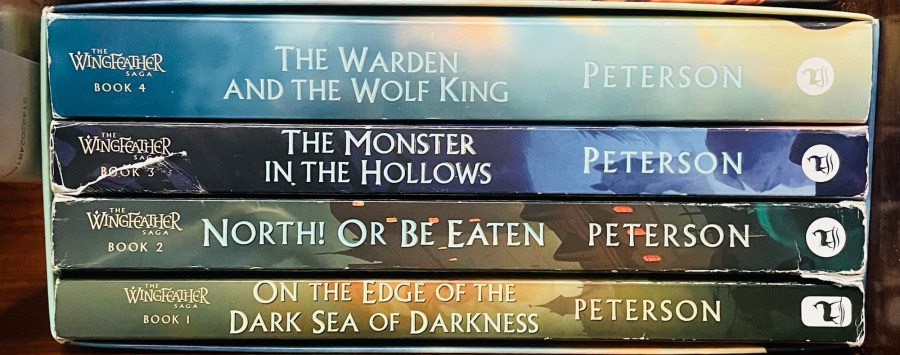
I first heard of the Wingfeather Saga through the tv show on Angel studios. As I am somewhat reluctant to simply let my kids watch anything by them, or by any children’s content producer, in blind trust, I looked into the background of the show. I was more intent in finding the heart of this show than other things my kids have watched because, frankly, I was really enjoying watching it with them! I love fantasy, and stories with solid families, and I really didn’t want to find out several episodes in that this was going to be some heterodox nonsense or violent horror. So as I looked into the background, I discovered to my delight that it was based on a book series by Andrew Peterson. A friend had given us a couple of Barnes and Nobel gift cards, so we went and picked up the set. Right away, our family was hooked. In fact, my oldest started reading ahead before I could stop her! (She comes by it naturally.) I did ask her to wait before reading the last book, and I’m glad that I did because it would have been…a lot for a six-year-old to read unaccompanied. The series is really meant for ages nine-years-old and up. But this is a series I would recommend for any family read-aloud and for any middle-grade aged child and above. The writing is beautiful, and I loved the stories as well. I think it is a sign of a well-written story when both children and adults enjoy it.
The Wingfeather Saga is a four book series: On the Edge of the Dark Sea of Darkness, North! Or Be Eaten, The Monster in the Hollows, and The Warden and the Wolf King. As can perhaps be gleaned from the titles, there are many tongue-in-cheek names and themes throughout the series, several of which amused me. (One of my favorite “side” characters is their friend Mr. Reteep, who is an “Appreciator of the Strange, the Neat, and/or the Yummy” and quotes random statements from books with hilarious titles.) (Along those lines, the land is called Aerwiar, named when the first fellow, Dwayne, said, “Well, here we are,” thus naming the land.) To begin, the story centers around the Igiby family, with the central characters being Janner, Tink, and Leeli, along with their mother, grandfather, and dear friend of “Books and Crannies” which is the most amusing locale in the book. They live in a land overtaken by the Fangs of Dang (sorry, how can you not laugh?) ruled by the evil yet mysterious Gnag the Nameless. Early in the series, they discover that they are much more involved with the central turnings of their world and lore than they ever realized and are sent on a quest for their lives, answers, and for home. Along the way, they learn hard truths and grow up and into their callings. While the narrative is mostly from the perspective of the oldest of the siblings, Janner, we do get to hear the thoughts and perspectives of his two siblings fairly often, especially in the last book.
Now, before I get to my favorite things in the book, I want to go over a few things that might give some parents pause. The books are definitely geared towards middle-grade readers. One of the things I love about the books is that they are fantastic for all children, but especially boys. But along those lines, there are some intense and, yes, even dark moments in the books. I don’t think these are reasons to not read the books, but that parents should be aware of before their kids read them. Or, better yet, as you read them with your kids. There is death and violence in the books, from beloved pets to treasured family members. Though there is very little blood (for example, the Fangs turn to dust when they die, which is an imaged loaded with meaning.) but the Fangs are not whimsical bad guys. They are real, evil bad guys. They have no issues with scaring small children, threatening them, or harming them or those they love. Towards the beginning, Podo (their grandfather) almost dies. Their father is to have died at the hands of the Fangs as well, along with their grandmother. There are also several creatures in the books that are creepy at best, and disturbing at worst. While Peterson has some amusing fantasy elements (like totaters and thwaps), and fascinating ones (like sea dragons and whistle harps), some creatures in the books (like toothy cows, horned hounds, and rock roaches) are as dangerous and wild as wild animals can be. Towards the middle to end of the series, we learn about how the Fangs came about, and some such creatures are disturbing (though perhaps more so for me than for my boys). There’s also a series of chapters where children are treated quite cruelly. There are wars, sword fighting, and battles of the will that are intense. Some people are deceptive and treacherous, and their actions have dire consequences. Peterson has written a real and true series, which is why I share these intense moments: they are part of the deeper narrative to this real fairytale-like story.
These are good books. They are real, true, and beautiful, where evil is defeated by the good. Peterson has written a series and a world that I think would have pleased Lewis and Tolkien. He gets what stories for children should and must be. One of the reasons I say these books are good for boys is because they don’t hedge around hard truths or soften real sacrifice. Sure, there are good books written for girls that don’t do that either. But if we’re being honest, most books written for children today are soft, bland, and temperate narratives that are hardly worth the paper they are written on. They aren’t even really entertaining.
The Wingfeather Saga is a series with strong and good families. They are not complete; no, they’ve been ripped apart by war and death and suffering. But there is never any question that their grandpa Podo is their head and he will protect them. That the greatest honor is not to rule but to serve and protect those entrusted to you (this is personified in the position of the Throne Warden, which is better discovered in the books). The men are good and real; rough and violent. Not for violence sake (though there are contrasting bad men as well, cruel and weak alike), but to defend the good. And along those lines, there is a clear sense of right and wrong in this book. Not that everyone is perfect, but there are consequences for your actions. One thing Podo reminds the boys is, “Don’t just follow your heart. Your heart will betray you.” And he’s right. Honestly, I wish I could quote dozens of lines from his books. There are so many great truths packed in there, but that one stood out to me from the beginning and made me realize this wasn’t going to be another fluff story.
There is also a consistent lore in the book that forms the foundation for the story itself. Like Lewis and Tolkien before him, this is a Christian story in a fantasy or fairytale setting. The first (fellows) man and woman were Dwayne and Gladys (which I just find amusing) and they walked with the Maker. But, as in true history, the world fell into rebellion, and people have been paying the consequences ever since. Even to the “start” of this story, the desire to be like God and to rebel again His commands lurks in the background of the narrative. Our main heroes and heroines pray to the Maker and ask for his wisdom and protection. And just like in life, sometimes the world just doesn’t seem fair. Why do I have to do this? Why am I being treated this way? Where are YOU? There’s real spiritual struggle in these books that I think hits at the heart of struggles many children (and adults) face at this time of life. Peterson lets his readers engage in that struggle. There was one scene in particular towards the end of the last book that reminded me a little of Orual from Till We Have Faces. And Peterson brings us out from there as well (but, I don’t want to ruin the ending. You’ll have to read it for yourself).
For yes, there is despair, temptation, and shame. These characters, even our favorites, are not perfect, they are human. They make mistakes, and they repent of them. Of the true things the story conveys, you are who you are, and to meld yourself into someone else will only bring misery and despair. Additionally, Peterson nails home the longing is us to be loved and named and wanted. And so, there is also redemption. There is truth, honor, and sacrifice. For this is a series written in the ranks of Lord of the Rings, The Chronicles of Narnia, Till We Have Faces, Redwall, and That Hideous Strength. A reckoning will have to be made for the sins of the world. Someone has to pay the price for a wrong they did not commit. Someone will have to protect those entrusted to their care because it is their duty and because it is right. The sacrifice broke my heart, honestly. I struggled with many “whys” in the last two books. But this is not a novel in the modern sense. This series is a fairytale, a true myth. There was no other way for the book to end, or to leave us with a future hope. For we have that future hope because of the Sacrifice made for us.
There are so many other things I could write about this series, but I would be afraid of spoiling the story. The themes, images, and scriptural parallels are beautiful and poignant. Peterson’s Wingfeather Saga displays that longing we have for a true and beautiful world, one that we can’t have here, but we know is out there. The longing for joy, for fulfillment, for peace, for rightly-ordered life. We long for the Shining Isle, and we long for the Home that is prepared for us. I hope you will read these books with your children and be inspired, encouraged, and enlivened.
Blessings to you and yours,
~Madelyn Rose Craig
 Madelyn Rose Craig