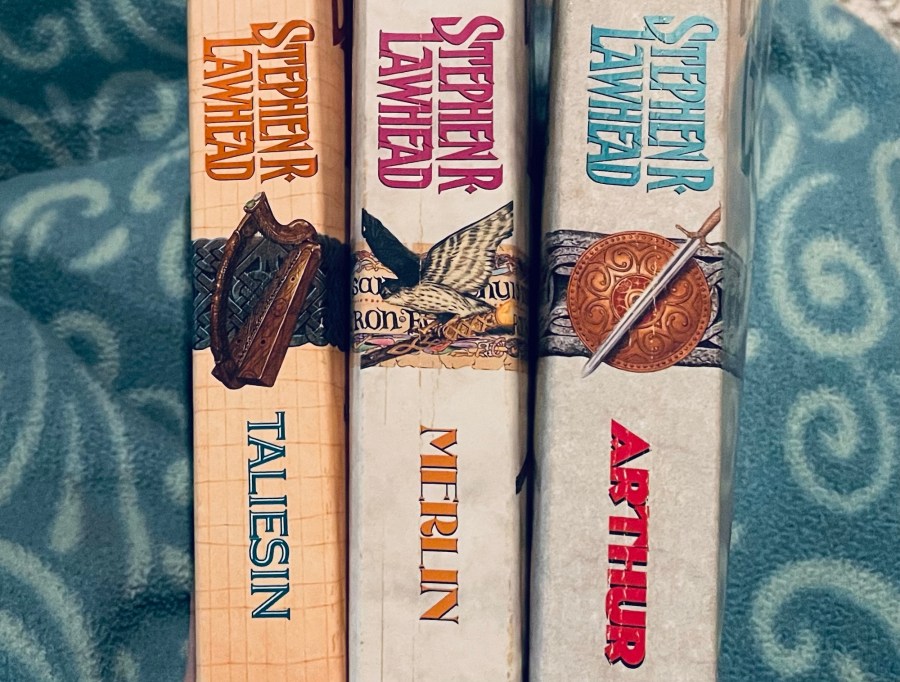
I meant to write this review months ago, but alas, here I am. I was introduced to this series through the Daily Wire when Jeremy Boreing announced he was going to do a tv series on it. My husband started the books and suggested I would really enjoy them, and he was right (naturally). While I do have my issues with the series, I found The Pendragon Cycle to be a fascinating mix of folklore and fantasy, history and legend, myth and Christianity. In this review, I will be focusing on the first three books of the five-book Pendragon Cycle series: Taliesin, Merlin, and Arthur. I apologize if I ramble a bit in this review. There is so much I want to say without revealing crucial plot points that would spoil the narrative. If you want the short version, skip to my last paragraph. But know this: despite the faults I find in the books, I really enjoyed the series and think many readers would enjoy the books as well.
To begin, I have only read the “first three” books of this series. Going in, I knew the series had five books total. But after finishing Arthur, I wondered if I should go on. The book felt rushed and incomplete, and I wondered how the final two books, Pendragon and Grail, would fit in. Since then, I discovered that Lawhead was forced to rush the third book if he wanted it to be published at all. Later, after another publisher took up the series, he was able to flesh out the remaining Arthurian stories, albeit with less of a cohesive timeline (according to some readers). In addition, some readers have suggested reading the fourth and fifth books between the second and third internal “books” of Arthur for continuity’s sake. Whenever I read those two, I will add my thoughts below as well. Now, onto the books of the series I have read.
I really loved Taliesin. In fact, I love it so much that I found an English translation of his Welsh poems so that I could read them. Yes, Taliesin, a fabled and loved bard of Wales, was a real person, as are many of the characters in this series. But you might be wondering, “Who is Taliesin, and how does he relate to any of the Arthurian legends I have read?” Well, Lawhead has crafted the perfect story to explain just that. As I mentioned, Lawhead melds legend and history into this fascinating fantasy series, blending the real and fantastic with the stories we all know and love, starting with Atlantis, with those we’ve probably never heard of. Yes, Atlantis (which apparently has a Welsh counterpart?) is part of this fantastic story. In Taliesin, we get legend in novel form from a third-person perspective about Taliesin’s background, the fall of Atlantis, the brutal world of Picts and Romans, and the parentage of the great Merlin. We also get the stories of two groups of people longing for a safe home, and of Taliesin’s dream of a Land of Summer, a world of peace and light and prosperity. Further, we get to see the (re?)introduction of Christianity to the British Isles, a subject I struggled with even as I appreciated it and will address below. Lawhead also takes some liberties with what we know about paganism in Britain at the time, and some of the history is out of order or extrapolated from incomplete accounts. Even so, this is a really great book and a compelling story, even more so if you know even a little bit about the history of Britain and Rome, Arthurian legends, and Atlantean accounts, and 22nd-century cultures (I promise that makes sense if you read the book). Also, not knowing those things does not take away from the story if you just like to read fantasy or historical-fiction adjacent books.
Picking up from Taliesin, Merlin speaks directly to the reader about Arthur, how he saved him from certain doom and preserved that future hope. But before he can tell us Arthur’s story, he must first tell his own. Actually, I think quoting the prologue to Merlin really sets the stage of the story and who Merlin is, a mysterious, powerful figure who is young in body but old in spirit.
They were going to kill Arthur. Can you imagine?
They would have killed him too, but I put a stop to it.
The arrogance! The stupidity! …So it did not matter what Uther said or did not say,
admitted or did not admit. I would have my way . . .
My way. Was it? Was it ever my way? There’s a thought.
Ah, but I am getting ahead of myself. I always am. This is to be Arthur’s story. Yes, but there is more to Arthur than his birth. To understand him, you have to understand the land.
This land, this Island of the Mighty.
And you have to understand me, for I am the man who made him.
I really loved the story of Merlin. It was a wonderful balance of fantastic folklore and modern prose. I think this is where Lawhead really shines. He takes these legends and expands them to novel form for the modern reader. I love epic poems, but I really treasure this aspect of Lawhead’s writing. Most of this story is told from Merlin’s perspective, but I think it really helps you, as the reader, get into the mystery of the man Merlin. There is also a bit of a time-jump in the middle of the novel that takes us from the “end” of Roman rule in Britain to how the peoples of the Isles adjusted (or struggled to adjust) to that power vacuum left by the Romans. And this is why we needed the backdrop of Taliesin to understand Merlin to understand Arthur. The complete narrative shows the harsh road Merlin tries to pave upon his return to continue his father’s dream of a united Britain, where there aren’t just war-leaders like his grandfather but lords under a strong king, a true king. Taliesin also sets the stage for characters like the Lady of the Lake, the Fisher King, and Morgian. But before these people can deal with the infighting and Picts to the north and the Irish to the west, the Saxons invade. This leads to the tales of Aurelius, Uther, and the birth (and rescue) of Arthur, not to mention the narrative of Merlin still wrestling with the Light and Darkness and working towards the Summer Land. There is a lot happening, yet somehow, Lawhead weaves it together.
The third book picks up with Arthur’s narrative and is full of much more fighting than the other two (though they are not without their bloody battles). The battles for the Isles with the Saxons, while brutal and long (and somewhat tedious to me), were still appreciated. I have largely read these stories from a post-Anglo-Saxon perspective and rarely from the perspective of the Welsh and Britons. So from a historical perspective, this part of the narrative was fascinating. While I noticed the rushed storyline while reading (and odd focus on the battle narratives that could have made room for more tales of lore), I understand better now that this wasn’t Lawhead’s intention. I look forward to reading the other books to get the rest of his re-told story. In general, you get the sense that Merlin is wrestling to find this perfect land on the Island of the Mighty with Arthur.
Now, I mentioned there is a bit of a time jump in the middle of Merlin. This is where the two main points of this series’ composition come into play. These books fall somewhere between historical fiction and legend. People like Elffin, the priest Dafyd, St. Martin, Maximus, Aurelius, and others are all real people. Even Taliesin, the bard and adopted son of Elfin, was real, though not necessarily that he was the adopted father of Merlin. But here is where things become muddled. Maximus died in 388, Taliesin was to have lived in the 6th century, and Aurelius in the 5th century. Some of the longevity of the characters, such as Merlin, his mother, and his grandfather, is accounted for by their Fair Folk ancestry. For others, well, legends and history get a little mixed up in some records. So, the timeline in the books is a little muddled, and the historicity sometimes feels a little…forced. Even so, it is fascinating to connect the legends with real events, for who knows how much of these tales were real accounts? Despite the flaws, the retelling is compelling and as fiction is most enjoyable.
But amidst this fantasy and legend, there is real history that must be grappled with. And more than the tales, there are the beliefs. Where the Atlanteans are shedding their ancient Near-East gods, the Welsh are depicted as worshiping in a very modern-perspective view of the druids. We are still learning about those beliefs, and I thought Lawhead took some liberties, but perhaps just enough to form a well-constructed world. But what troubled me most was his interpretation of Christian beliefs. While on one hand, I can appreciate how those like Taliesin and his mentor might try to combine what they know and what they are learning to make sense of Christ, I cannot appreciate everything that Lawhead did in portraying that. I feel at times he leaned a little too unitarian in his thinking, and the universalism was at times too strong for my tastes. I did not feel comfortable with the extra-biblical revelations and appearances of God to Taliesin, nor how the priests seemed to just accept his words as truth. I see no world where the priests would have thought it perfectly fine to mix druid and Christian beliefs and practices. I don’t think it was historically accurate (or believable), good Christian teaching, or necessary for the story. I think the books would have been worlds better without it. Even so, I am glad for a narrative that doesn’t completely ignore Christianity’s presence in Britain at the time and the role it played in its further formation.
Along these lines, I think Christianity and a striving for a perfect world answer the question of “what is the kingdom of Summer” that Taliesin foresees and longs for. I think, and Merlin clearly thinks, that this is a world that can be formed on Earth. It is something of a Utopia, but it is also the deep, human longing for a return to Eden. It is also a hope for Christ to come again, though I think neither Taliesin nor Merlin understand that (who does?). So Merlin puts his hopes in Camelot and Arthur, who is preserved for a later world. In this way, the historical-legend falls way to the fairytale. These are the struggles one must fight on earth, resisting evil and working towards the good. And this is not just for yourself, but for all people, and for the Good, to the truth which is Christ. But as that cannot be found here, those true things are kept away for a later revealing. And here, legend meets history, and these meet the true fairytale, and we walk those fragile narratives in our own lives as we await the second coming of our True King.
The Pendragon Cycle is a compelling narrative that manages a believable balance between fantasy, historical fiction, and legend retold for the modern reader. Lawhead blends the real and fantastic with the stories we love in a skillful way, even when there are one too many battles for my taste and frustrating publishers rush things. My biggest complaints with the books are these: 1) God was made a character, 2) the blending of paganism with Christianity went beyond my suspension of disbelief. But I am glad for the strong, true Christian presence that is rare for this genre of fiction and one that isn’t sappy like most Christian fiction. You will hear histories from many perspectives in this book, be compelled to look up facts that perhaps you hadn’t considered before, and hear those tales from old in a way that makes them about as real as they can be, even if not exactly how they were. I wouldn’t hand these books to an undiscerning Christian or a reader not prepared for graphic battle depictions (not gratuitous, but not undetailed either). If you enjoy fantasy and historical fiction, and especially if you enjoy Arthurian tales, this is definitely the series for you. Also, if you haven’t checked them out yet, the Daily Wire live-action series The Pendragon Cycle is a fantastic book-to-screen adaptation. There is no medieval drab here. The sets, costumes, and acting are fantastic. Even just two episodes in, I am hooked. The ending had me in tears, even though I knew what was coming. Best yet, the producers value the source material and are faithful to the original story. I cannot wait to watch the rest. (Why couldn’t the producers of WOT do this??)
Blessings to you and yours,
~Madelyn Rose Craig
 Madelyn Rose Craig