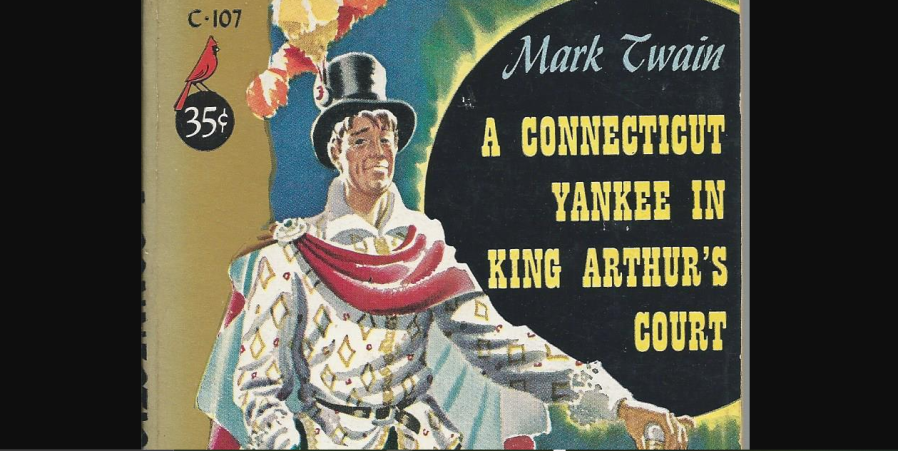
Honestly, until a friend of mine mentioned A Connecticut Yankee in King Arthur’s Court and said that I should must read it, I’m not sure I had ever heard of this book. I might have seen a copy at a used bookstore once. But I’d been so focused on Huck and Finn, and Tawin’s various short stories, that it has only been recently that I’ve looked into Twain’s other works. Not long ago, I read The Prince and the Pauper and greatly enjoyed it. While there were similarities between the two books, if you think you will know anything going into A Connecticut Yankee besides tomfoolery and shenanigans, you are wrong. You don’t know what to expect or what is coming. Though it may not be everyone’s cup of tea, this is Tawin doing fiction at its finest. And so, thinking I knew something yet knowing nothing, I dove into this book.
As the title suggests, this story comes mostly from the perspective of Hank Morgan, who hails from Connecticut (like Twain) and is transported to the days of King Arthur. After dazzling the superstitious citizenry, he quickly works his way up to becoming an advisor to the king. To do this officially, though, he even comes up with a title for himself, which is frequently used to humorous effect: the Boss. (As a side note, I don’t think it is a coincidence that his last name is Morgan.) While the book may appear at first to be an old-fashioned quest wrapped up in a time-traveling historical fiction novel, it somehow manages to be more than that.
It’s understandable why perhaps many haven’t read this novel. It is very long, and it focuses on knights and legends and things much older than the US, which so many of Twain’s other books are centered on. It is also perhaps one of his most melancholy works, despite all the hilarity that ensues within. The story is more than the tale. It is a commentary on the shortcomings of human nature. One particular scene that stood out to me was towards the end of the book. A mob, out of fear, descends on their neighbors at the command of their lord and hanged them. The next day, their children “play mob” and do the same with their friends, but they don’t realize they might actually kill someone, a friend. For them, it was just pretend. But “It was some more human nature;” Twain through Hank recounts, “the admiring little folk imitating their elders… and had achieved a success which promised to be a good deal more serious than they had bargained for.” Like many scenes in this book, this one lead me to consider how often we do something and forget we teach our children. What are the long-term consequences that come to us by nature as people?
It’s easy to get lost in the expanse of the story. So much of it seems ridiculous and “where is he going with this?” until you get close to the end and you see what it is all leading to. And you don’t see everything, but you can see it. We all see it. And it ain’t pretty. One of the main threads of the story is Hank attempting to modernize the Arthurian kingdom. Hank believes himself more advanced, more competent than these rustic people. But you can’t just modernize people and make them better; you can’t advance without a moral center. Despite all he does, Hank can’t change sinful nature, including his own. Without a change of heart, people will burden, enslave, and dehumanize other people; they will seek power, consider themselves higher than they ought, and raise their children the same. In the end, not even Hank is able to resist those human temptations and shortcomings. Even so, his last wish is not for the world he created but a simpler, wholesome, familial one that he lost in hopes of gaining the world.
This book manages to be sci-fi, dystopian, and historical fiction all in one. Hank travels in time to deal with the issues of Twain’s day and shows where those issues unresolved (and in a way, did) lead. A Connecticut Yankee in King Arthur’s Court is a social commentary on Twain’s time, but in the old way (somewhat new for him, though), crafting an enticing narrative that allows us to come to our own conclusions along the way. And thus, it is timeless. His book was good for the centuries before it was written, it was crucial for his contemporaries, and it is edifying for us today. While I cannot endorse all of his criticisms, I can sympathize with them. Evil can be found anywhere, but so can the simplest solutions. Most are found right here in our humble homes. I’m glad my friend (strongly) suggested that I read this book. I learned and am still pondering much, and I hope you will as well.
Blessings to you and yours,
~Madelyn Rose Craig
 Madelyn Rose Craig