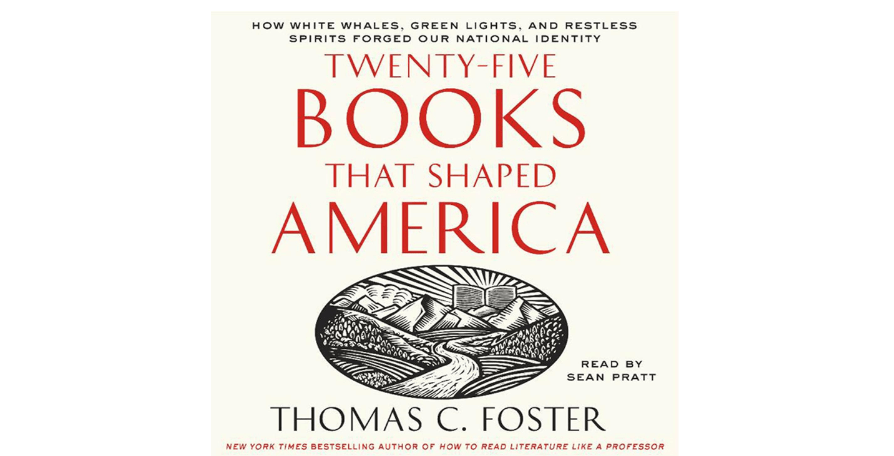
Several years ago, I read How to Read Literature Like a Professor by Thomas Foster. I really need to read that one again. But when I saw another book by the same author at the used bookstore, I knew I had to get it. There are few authors whose books I buy when they are available for preorder or I see them at the bookstore, but he is apparently one of them. I flipped through the table of contents and thought, “You know, this looks like it’ll be about as interesting as that other book.” So, I bought it.
In reading 25 Books That Shaped America, I was reminded that I have honestly read very little in the way of American literature. Yes, I have read a lot, nearly all in college. We read some smatterings of each generation of literature, but it was very narrowly focused. These are the main authors; these are the lesser-known authors; this is the different stuff they wrote; this was the stylistic period. The basics, you know? And I didn’t enjoy a lot of it. Sure, I love me some Poe and O’Connor (which, sad to say, never make an appearance in this book?), but in general, I find a lot of American literature a little too progressive, or rebellious, or at least not as rich as English and other ancient world literature. What is Whitman compared to Beowulf? But in reading this book, I also have a better understanding of why I don’t prefer a lot of American literature. I think my main point of contention is that a lot of our writing changed too much too fast. You can barely point to different stylistic generations because, as the author points out, so many of these writers and their books that shaped America did just that: they shaped America. They individually formed new paths, doing things that hadn’t been done before. And while I may never love a lot of our own literature, I at least have a better appreciation for it.
And that is the main thing I loved about this book. You see, very often, Foster gets so wrapped up in talking about the books that you can miss (and sometimes, he doesn’t flesh out as much as I’d like) what it is about that specific book that shaped America. But he talks about them in such a way that you know he loves literature, and he very much so wants you to love it too. It’s like he’s trying to introduce you to a friend and goes, “I just want you to meet them. Maybe you hit it off, maybe you don’t.” And you just love that he loves them and you can’t help but love them a little bit, too. He has an infectious love for literature.
Still, I did not always love everything he had to say. Some of these books I had read before, some I hadn’t, and a few I’d never heard of before, though I know their descendants. Similarly, I agreed with many of his assertions, was intrigued by others, and bristled at some. He is often more liberal-leaning than I care for. And yet, I have learned so much in reading this book. As I hoped, and as he has done before, Foster helps me look at the world of literature in a new light. And, as this is a book about America, Foster shows how literature was shaped by who founded America and how it helped bring to fruition what America wanted to and could be. Around halfway through the book, he addresses what parts of the American Dream, Declaration of Independence, and Bill of Rights still needed to be realized when such and such work of literature was written. Many of our novels show that the Revolution wasn’t a one-and-done thing but the start of a building, dare I say, a sanctifying process that could build a new and better country, a more perfect union, a different people that took the best of others and made it one. Some of these works of literature make us itch, but they are our history and there for us to learn from. They were written at a time when many were bold to ask, “What could be?”
In a similar way, this book isn’t all that could be regarding the discussion of American literature, and the author freely admits that. These aren’t The 25 Books that Shaped America, just 25 that he thinks did. These are books that we can learn from to tell us about who and what we came from and how we got to where we are. Foster’s book shows how America(ns) made these books what they are and how these books made America(ns) what she is and we are. We have a different yet rich history in literature that is still being formed. That is part of what makes it American literature. Our literature is new, innovative, boundary-pushing, revolutionary, fiercely independent, and (the good ones at least) full of a desire to learn, teach, and make us better. These authors sought to preserve what was to teach contemporaries and descendants alike, to forge new paths both in literature and in our beloved country. Foster’s book is full of new insights and helpful instructions on reading books in their proper context. It’s a book about books. And if you love books and love reading, and you still like to learn, this is the book for you.
Blessings to you and yours,
~Madelyn Rose Craig
 Madelyn Rose Craig