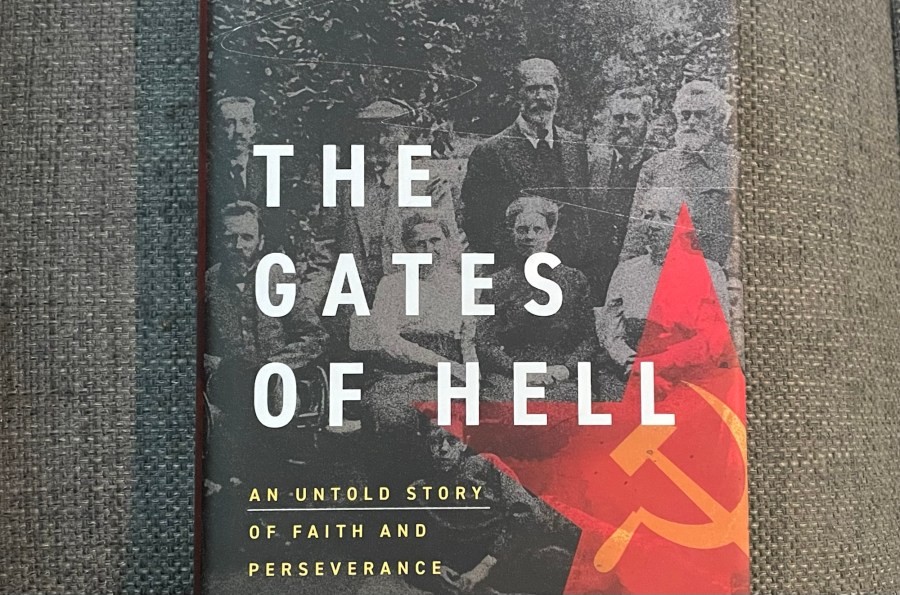
A friend shared that he had read this book about three years ago and said that it was a great resource for learning about the Lutheran church in Russia. The author’s family was Russian Lutherans, so the topic was near and dear to him. Another friend read it and said it was angering; still another friend said it was filled with deep sorrow and great hope, and that there should be a commemoration of the martyred that fills its pages. So finally, about a year ago, I ordered a copy. When I received it, I flipped through a couple pages and determined that perhaps I should not read it when I was still very pregnant. I don’t think I could have handled emotionally then. But now, a year later, I am so glad I did read it. Echoing the words of my friends, this book is a rich resource, an angering account, a stirring narrative, one filled not only with so much sorrow but also a resounding hope.
Rev. Dr. Matthew Heise, as I mentioned, is the descendant of Russian Lutherans, so he had some connection to the people in this account. But it wasn’t until he was serving in Russia and heard first-hand the accounts of the people who suffered under the Bolsheviks that he began compiling the history for this great book. The Gates of Hell compiles the history of Lutherans in Russia, including their joys and their perseverance through their struggles, even unto death. There is a brief history of their origins, but the majority of the book focuses on the time from the start of the Bolshevik Revolution until the start of WW II, concluding with the stories of those who quietly persevered from the closing of the last church in the USSR in 1939 until their reopening in 1992. At the start of the Revolution, the Lutheran church was the second largest church in Russia, surpassed only by the Russian Orthodox church (you can get a small glimpse of that here). By the end, the Soviets had essentially stomped out all worship, or so they thought. Through systematic financial, spiritual, political, and violent persecution, the Soviets, emboldened by their worship in their atheist death-cult called communism, tore apart the churches of Russia. But though the Soviets took all the Christians had and tortured their bodies, the Church prevailed. Yes, the visible church diminished, but even in the gulags, the pastors served. In the homes, mothers instilled faith in their children. And the faithful work of those hopeful Christians planted seeds that grew quietly for the day when they could worship publicly again. Some patient Christians even were able to worship in the same churches their former pastors and fathers had served in, despite the destruction of so many other churches.
And along those lines, I cannot move past the terrible anguish I felt while reading this book. Heise’s account is chilling. Even with what I already knew of this time in history, reading the systematic approach the communists took to break the bodies and the spirits of the Christians is horrifying. There is no neutral ground here. For the Soviets, you either worship the state or you die. And thus, the faithful Christians paid a terrible cost. They were lied to, attacked, beaten down financially to the point of starvation. Their homes were stolen from them, and they were made to work against their own people, some to eventual freedom and most to their deaths. They were tortured in mind and body. But these martyrs knew that God did not abandon them, and they joined the Church Triumphant.
It struck me partway through the book that one should keep a small catechism open while reading The Gates of Hell and notice how everything the Soviets did was distinctly anti-God and His commands. Just follow along and see how those “heartfelt” initial hopes of the socialists quickly showed their true atheist colors. Consider these things: You cannot serve God before all things. You cannot worship Him. You MUST participate in mocking Him. You must reject tradition, dishonor parents, and reject all authority but the state. Murder, adultery, and theft are celebrated. Spying on and lying about your neighbor is celebrated. Coveting and taking another’s position and possessions are a core tenet of this hellish death-cult. To be a good citizen was to hate God and His Word.
It is mind-boggling to read this book from a Christian and American perspective. I don’t think we cherish enough what we have here in the US. We have a country that values freedom of religion and freedom of conscience, that allows someone to own not only their home and possessions but also the work of their hands. These blessings are not a given in communism. No, worse, it is specifically taken. While there were specifically “non-persons,” notably pastors and their families, under communism, a person is not a person. You are only a member of the state. Sometimes I wonder if the American system of government (an implicitly Christian kingdom made for a moral and religious people) is better than the explicitly Christian kingdoms that once existed, but I know it is worlds better than the hellish death-cult of communism.
This stirring book is a worthy read for any Christian. In this book, we hear the stories that the communists wanted forgotten, the tales of woe and hope of our brothers and sisters in Russia. They followed the words of Paul, that after they have done everything, to stand. They were faithful until the last and received the crown of life. Their lives and their deaths are an encouragement to Christians everywhere who suffer under persecution, and an inspiration to those who prosper to give aid and encouragement to those who suffer when they can. And no matter the suffering, this we know:
Though hosts against us stand arrayed,
Christ bids us still, Be not afraid;
Though all its powers the truth assail,
The gates of hell shall not prevail.
Blessings to you and yours,
~Madelyn Rose Craig
 Madelyn Rose Craig