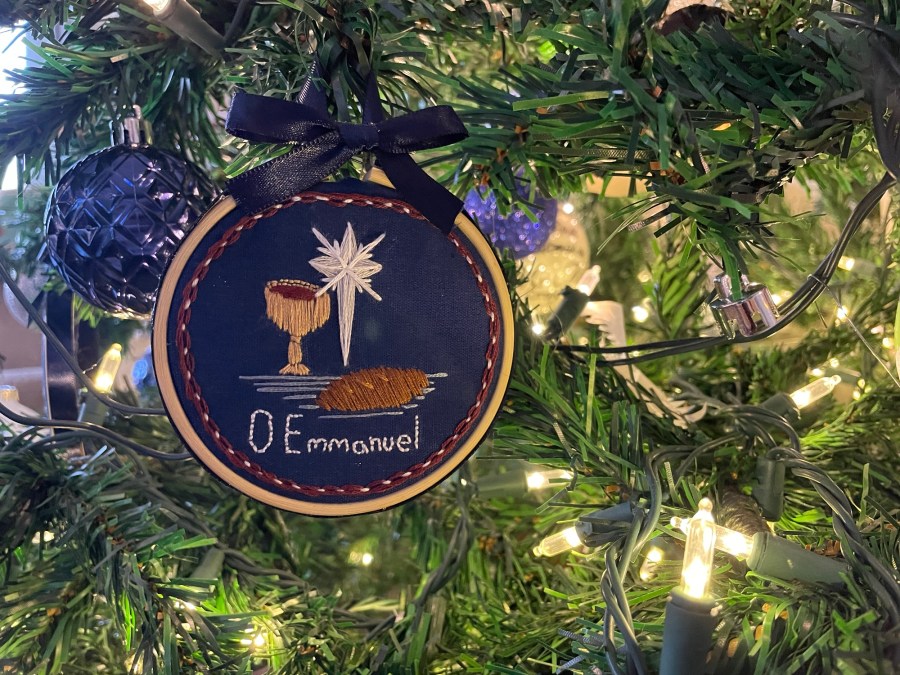
December 23rd : O Emmanuel, our king and our Lord, the anointed for the nations and their Savior: Come and save us, O Lord our God.
I originally posted this on a friend’s blog but updated it for this series here.
The hymn “Let All Mortal Flesh Keep Silence” has a long and beautiful history. While there is some dispute on the date of composition for the hymn and the liturgy it is associated with, it is believed that it was originally written by St. James the Less while he was bishop of Jerusalem. A thirteenth-century writer recorded that James performed the first mass held in Jerusalem, and his chanted prayer before the Eucharist was the original text for this hymn.
Let all mortal flesh keep silent, and stand with fear and trembling, and in itself consider nothing earthly; for the King of kings and Lord of lords cometh forth to be sacrificed, and given as food to the believers; and there go before Him the choirs of Angels, with every Dominion and Power, the many-eyed Cherubim and the six-winged Seraphim, covering their faces, and crying out the hymn: Alleluia, Alleluia, Alleluia.
This text became part of what is known as the Divine Liturgy of St. Another name for it is the Liturgy of Jerusalem. James. Originally in Greek, the brief stanza given above was said during the Anaphora, or offertory, at the center of the Divine Liturgy. Here, it is titled the Cherubikon, or Cherubic Hymn, due to its depiction of the angelic host surrounding God in heaven. Considering its namesake, this is likely the oldest Liturgy of the Eucharist.
The Church fathers, such as St. Cyril of Jerusalem and St. Basil the Great, wrote on the liturgy and hymn. The liturgy has been adapted from its original form, and even today presents itself in multiple forms within the Greek and Syrian churches. But the text has been in use as a hymn since at least the third century. In fact, this hymn was adopted for the Cherubikon in the Divine Liturgy of St. Basil the Great, who lived during the fourth century, thus expanding its use into the Byzantine Church. From here, the hymn spread throughout many liturgies and churches from East to West. Now, some of these liturgies are only used during certain times of the year. For example, that of St. Basil is celebrated only a few times per year, and this hymn is sung only on Holy Saturday. Although the Liturgy of St. James is typically performed on his feast day in October and the Sunday after Christmas, the hymn is sung all year in Jerusalem. This hymn or chant can be found in churches throughout the world, and traditional variations of the text can be found here.
The modern hymn has been translated from the Greek text, and we credit its poetic beauty to Gerard Moultrie. Born to an English clergyman and hymn-writer in 1829, Moultrie became a hymnist, translator, chaplain, and schoolmaster during his life. He also held many positions at the Shrewsbury School. Fascinatingly, his great-grandfather actually settled in South Carolina before the Revolutionary War but returned to England after the war began. Moultrie’s adaptation of St. James’ prayer was published in 1864 within the Lyra Eucharistica as the “Prayer of the Cherubic Hymn.” He also edited and wrote several other hymnals before his death in 1885. But of all his works, his translation of “Let All Mortal Flesh” is his best known.
The tune we use for this hymn today was arranged later by Ralph Vaughan Williams. He took the tune of a well-known French melody from the 1600s and adapted it for The English Hymnal in 1906. He may have learned of the melody from a book published in Paris in 1860, where it was called “La Ballade de Jesus-Christ,” though he also could have adapted the melody from another French book published just two years before his own composition. The tune is called “PICARDY” after the area it is assumed to have come from.
This tune has a haunting beauty. We hear it, and pause, dwelling on the words and their significance, on the reverence of the text and music. And reverence is what is called for during the celebration of the Eucharist. Though this song always brings me back to Christmas, this hymn is first and foremost about the adoration of our Lord from Advent to His sacrifice, and to His promised return.
Let all mortal flesh keep silence,
and with fear and trembling stand;
ponder nothing earthly-minded,
for with blessing in his hand,
Christ our God to earth descendeth,
our full homage to demand.
Today is the seventh and final day of the O Antiphons, and on it we remember Christ as the Emmanuel: our God with us, anointed Savior in the flesh. With all the beauty in the tune, the hymn begins with solemn reverence to the coming and presence of the Lord. We are given three commands in this stanza, and a fourth is implied. The first is to keep silent before the Lord, the second is to stand in fear and trembling before our God, and the third is to keep our minds off the things of this world but instead on Christ (Psa. 2:11, 46:10, Hab. 2:20, Zeph. 1:7, Col. 3:2-3). Finally, as Christ has come down to us, he deserves our respect, our faithfulness, and our reverence (Psa. 2:11, Isa. 40:5, Phil. 2:5-13, Zech. 2:13).
This stanza also transcends time. Indeed, something similar occurs in each verse as we recall what has been, what is, and what will be. First, we picture our Lord surrounded by worshippers after His birth, all remaining silent and still, standing in awe of Who is before them. Yes, consider this Eucharistic hymn: God here for us! Considering our frailty and mortal form, knowing we desperately need God’s grace, mercy, and forgiveness, we stand in awe before partaking of the Lord’s body and blood, given and shed for our redemption (Col. 1:13-14). So, we look back to when the Lord descended not in majesty but in human flesh “with blessings in His hand” to bring us His Gospel and save us from our unrighteousness (Isa. 9:6, 52:13-53:12, 61:1-3). And we look on now in awe and reverence at the sacrificial food given to us.
King of kings, yet born of Mary,
as of old on earth he stood,
Lord of lords, in human vesture,
in the body and the blood,
he will give to all the faithful
his own self for heav’nly food.
The second verse focuses more on who Jesus is and what that means for us. Who is Jesus? He is God made man, our Lord in flesh, the incarnate Christ (Rev. 19:16, Isa. 7:14, Jhn. 1:14). He went from glory and lowered Himself to a human birth, yet He was and is the same as at creation—eternal God (Mat. 1:23, Phil. 2:6-7, Gal. 4:4, Jhn. 1:1-3, Rev. 1:8). But while Christ was Lord and King in human flesh, He is also present in the bread and wine (Luk. 22:19-20). He was King and Lord at creation, at His incarnation, and is when we partake of Him in the Lord’s Supper. These lines more than describe who this great and awesome Savior is; they also instruct and remind us of who graciously gave His body and blood to eat and drink, Himself our manna from heaven to deliver us from eternal death (Jhn. 6:47-58, 1 Cor. 11:23-26, Rom. 8:32, Eph. 2:8-9). This is why He came! The message of this verse is of our Lord and Savior—who was and is—coming down to us (not us to Him) to save us (Col. 1:19-23).
Rank on rank the host of heaven
spreads its vanguard on the way,
as the Light of light descendeth
from the realms of endless day,
that the pow’rs of hell may vanish
as the darkness clears away.
Again, this verse looks at what was, what is, and what is to come. Then—at creation—the heavens and angels sang the praises of God (Job 38:4-7). Then—at the birth of our Lord—the angels heralded His arrival (Luk. 2:8-14). And what better use of an angelic army than to lead the way before the coming of the Lord! For that is what a vanguard is. How powerful a picture the verse paints, too, of the ranks of angels advancing before the coming of the Lord! And how perfect a picture to describe the dwelling of God as the realm of endless day! For what else would a realm look like with the presence of Christ (Jhn. 1:1-5, 3:19, 8:12)? Thus, the Lord had come, our eternal light and life, and destroyed the darkness of death on the earth (Isa. 9:1-6, Eph. 5:6-11). And now that He has come, we have been saved from the wiles and power of the evil one, and death no longer has any power over us, for we live in the light of life (Psa. 56:13, Isa. 53:11, Jhn. 1:1-5, Heb. 2:14-15). Moreover, he will come like this again (Acts 1:11, Dan. 7:13, Mat. 16:27, 25:31-33, Rev. 1:7, 7:11-12).
At his feet the six-winged seraph,
cherubim, with sleepless eye,
veil their faces to the presence,
as with ceaseless voice they cry,
“Alleluia, alleluia,
alleluia, Lord Most High!”
Finally, we get to the reason why this type of hymn is called a cherubikon. Here at the end, we look up from earth to heaven where angelic beings surround the Lord’s throne and give Him praise. Where the first verse instructs on how we mortals should respond in the presence of the Lord, the last illustrates how the beings who are constantly in the presence of the Lord give unending praise (Rev. 7:11-17).
The text weaves verses from throughout Scripture, but it mainly draws from the descriptions of the angels from Isaiah and Revelation (Isa. 6:2-3, Rev. 4:8). I do find the description “sleepless eye” somewhat ironic since the depiction of some angelic beings includes that they are covered with eyes. And we, too, would likely be like Isaiah if we were to have such a vision (Isa. 6:5). For who are we to stand before God? Yet we stand in the presence of the Lord when we gather in His name. How wonderful it is to be welcomed by Him!
We once again remember what was, what is, and what will be. We have the angels who have been praising since the Creation, and we get a glimpse of what it will be like when we see the Holy One seated on His throne (Dan. 7:9, Rev. 19:4-6, 21:3). But remember, this song is in preparation for the Eucharist. This hymn was meant for now. For when we sing the three “Alleluias,” we sing what the angels proclaim at all times, our voices joined together in a shout to the glory of the Lord!
Thus ends the song in reverence and adoration to the Lord and to His body and blood, given and shed for us that we might live eternally with Him (Psa. 103:17-22, 148:2, Eph. 1:3). Amen.
Blessings to you and yours,
~Madelyn Rose Craig
Works Referenced
“Anaphora.” Ed. Leuker, Poellot, Jackson. Christian Cyclopedia. Concordia Publishing House. 2000. “
Carl Draw. Glory to God: A Companion. Westminster: John Knox Press. 2016. p. 352.
“Divine Liturgy.” Ed. Leuker, Poellot, Jackson. Christian Cyclopedia. Concordia Publishing House. 2000.
“Divine Liturgy of St. James.” Trans. James Donaldson. From Ante-Nicene Fathers, Vol. 7. Ed. Alexander Roberts, James Donaldson, and A. Cleveland Coxe. (Buffalo, NY: Christian Literature Publishing Co., 1886.) Revised and edited for New Advent by Kevin Knight.
“Gerard Moultrie.”Songs and Hymns.
“Here followeth of St. James the Less.” The Golden Legend. Trans. William Caxton, 1483; Author Jacobus Voragine. 1275.
“Let all mortal flesh keep silence.”
“Let all mortal flesh keep silence.”
“Liturgics.” Ed. Leuker, Poellot, Jackson. Christian Cyclopedia. Concordia Publishing House. 2000.
“Liturgy of Jerusalem.” Fortescue, A. (1910). Liturgy of Jerusalem. In The Catholic Encyclopedia. New York: Robert Appleton Company.
“PICARDY.” Songs and Hymns.
 Madelyn Rose Craig