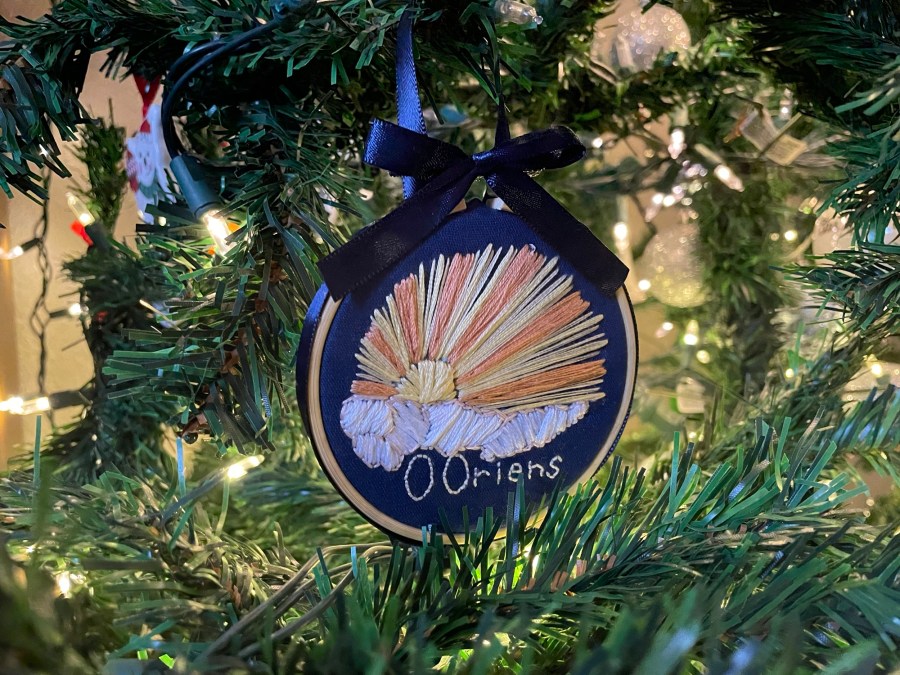
December 21st : O Dayspring, splendor of light everlasting: Come and enlighten those who sit in darkness and in the shadow of death.
Brightest and best of the stars of the morning,
Dawn on our darkness and lend us thine aid;
Star of the East, the horizon adorning,
Guide where our infant Redeemer is laid.Cold on His cradle the dew-drops are shining;
Low lies His head with the beasts of the stall;
Angels adore Him in slumber reclining,
Maker and Monarch and Saviour of all.Shall we not yield Him, in costly devotion,
Fragrance of Edom and off’rings divine,
Gems of the mountain and pearls of the ocean,
Myrrh from the forest and gold from the mine?Vainly we offer each ample oblation,
Vainly with gifts would His favor secure,
Richer by far is the heart’s adoration;
Dearer to God are the prayers of the poor.Brightest and best of the stars of the morning,
Dawn on our darkness and lend us thine aid;
Star of the East, the horizon adorning,
Guide where our infant Redeemer is laid.
This hymn was written for Epiphany in 1811 by Reginald Heber. He was born in England in 1783, became a vicar at his father’s church in Hodnet, adn then a bishop in Calcutta, where he devoted himself to his people for three years before his death in 1826. The first line of “Brightest and Best” has at times been adapted to say “sons,” “stars,” and “suns” in various hymnals. As many hymnologists have noted, this particular word has caused quite a stir. Due to perhaps an ignorance of the different names or addresses for Christ, many hymnal compilers struggled with wanting to add this particular hymn as some considered it “star worship.” In actuality, this star, like many symbols in Scripture and hymns, has a twofold meaning: it is both a reference to the star that the wise men followed to see the Messiah and to the messiah Himself – our light and life. Over the years, the hymnals that did include the hymn have removed and added verses, and it has become a well-loved hymn, with one hymnist even translating the text into Latin in 1871.
The tune Heber intended for this hymn appears to be one scottish folk tune called WANDERING WILLIE, once used for a poem by Robert burns. However, it has been paried with several tunes over the years and never once printed with that intended tune. One shapenote hymnal used STAR OF THE EAST, another hymnal using EPIPHANY, and then the most common tune, and the one used in the Lutheran Service Book, MORNIGN STAR by James Harding, choirmaster and Organist at St. Andrew’s Church in London. This tune was composed in 1892 as part of a larger arrangement and first used in a hymnal in 1901. It wasn’t paired with “Brightest and Best” until 1905 for a Methodist hymnal and was then added to a Lutheran hymnal seven years later. Thus, its long history finally found a resting place in the hymnals and hearts of Christians as a song of penitential longing and hope in the arrival of our Savior.
Today is the fifth day of the O Antiphons, and on it we remember Christ as the Dayspring: our light and life (Luke 1:78-79). As mentioned above, the star we sing of is not just in remembrance of the “Christmas star” that guided the wise men, but it is also Christ, the Bright Morning Star (Rev. 22:16). He is the light that has shown on our darkness (Isa. 9:2; John 1:1-5). He is the one who will shine on the last day! But yet, this star is a reminder of that star that shone on Christ’s birth, one that reminds us during Advent to lead us back to the manager, which God became man. We look to that humble cradle, where our Lord was not adorned with jewels but with the dew; he was not surrounded by dignitaries at his birth but by animals and shepherds. Yet the angels sang of His birth to our edification: peace on earth, and goodwill on whom His favor rests (Luke 2:8-20). As this is an epiphany hymn, the text reflects on the gifts of gold, incense, and myrrh, not present at His birth much much later a the meeting of the magi (Matt. 2:9-12). But the text begs us to ask ourselves: at the Advent of our Messiah, shall we not yield Him all things? Yet even if we do, it is not these gifts that secured our salvation. God desires mercy and penitence, prayers and humility (Psa. 51:17; Isa. 57:15; Micah 6:8; Matt. 9:13). Even so, none of these had we offered by Christ’s arrival; none of these would have sufficed for our redemption. He is our light and life. Thus, we sing again of the best of these stars, of the light shining out of the darkness, of our helper and bright sun, of our Redeemer who came as a helpless babe while we were yet powerless, to live and die for us.
Blessings to you and yours,
~Madelyn Rose Craig
“400.Brightest and Best of the Stars of the Morning.” The Lutheran Service Book. 2006.
“Lutheran Service Book #400.”Hymnary.org.
“MORNING STAR*169.”; “Brightest and Best*169.”Evangelical Lutheran Hymnary Handbook.
“When All the World Was Cursed.” The Free Lutheran Chorale-Book.
Fenner, Chris. “Brightest and Best of the sons of the morning.” Hymnology Archive. 2022
“Brightest and Best of the sons of the morning.” Ed. John Jullian. A Dictionary of Hymnology. 1892
 Madelyn Rose Craig