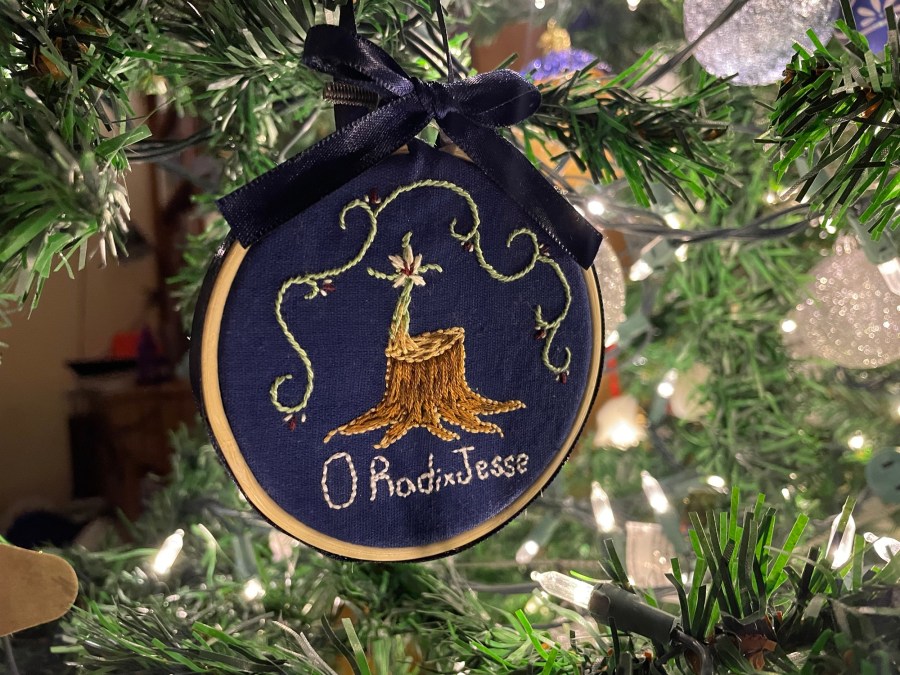
December 19th : O Root of Jesse, standing as an ensign before the peoples, before whom all kings are mute, to whom the nations will do homage: Come quickly to deliver us.
Lo, how a rose e’er blooming
From tender stem hath sprung!
Of Jesse’s lineage coming
As prophets long have sung,
It came, a flow’ret bright,
Amid the cold of winter,
When half-spent was the night.Isaiah ’twas foretold it,
The rose I have in mind;
With Mary we behold it,
The virgin mother kind.
To show God’s love aright,
She bore to us a Savior,
When half-spent was the night.This flow’r, whose fragrance tender
With sweetness fills the air,
Dispels with glorious splendor
The darkness ev’rywhere.
True man, yet very God,
From sin and death he saves us
And lightens ev’ry load.O Savior, child of Mary,
Who felt our human woe;
O Savior, King of glory,
Who dost our weakness know:
Bring us at length we pray
To the bright courts of heaven,
And to the endless day.
This hymn was originally an old German carol of two verses called “Es ist ein Ros entsprungen” from the 14th century. No one is quite sure who penned it, but it was a favorite among Catholics at the time of the Reformation. It was first officially published in the Speyer hymnbook in 1599, along with an additional twenty verses. Only ten years later, the great Lutheran composer Michael Praetorius set the original two verses to music for four voices. He brought this beloved hymn to the Lutheran church, and, it is said, adapted the verses to focus on Christ while still preserving the Marian theme of the original text. Since then, it has become a beloved hymn among all Christians. Some hymnals today have just the two original (or adapted) verses; others, such as the Lutheran Service Book, have four; still others, including old Lutheran hymnals, have five or even six stanzas, some of which come from the 1599 text or add new verses altogether.
Several translators of the 19th century brought this text to English and added the additional verses, including: musicologist Theodore Baker (st. 1-2), translator Harriet Spaeth (st. 3), and Rev. John Mattes (st. 4). These last one or two verses appear to have been authored by Lutheran pastor and hymnologist Rev. Friedrich Lariz in 1844. His verses transition the hymn from a carol and prophetic retelling of the original text to a didactic hymn of praise and petitioning to God, which is common among many Lutheran hymns.
Today is the Third day of the O Antiphons, and on it we remember Christ as the Root of Jesse: our foundation and our King. He is a King of David’s line, a son of Jesse, the King who was and is and is to come (Ruth 4:17; Isa. 11:1-2, 10; Matt. 1:20-21; Luke 2:1-5, Rom. 15:12). Before Him, the King of kings, all will worship (Phil. 2:9-11). But this hymn focuses on a simpler majesty. Our God became flesh, born as the Son of Mary (Luke 2:6-18). In the first lines, we see a two-fold rose: Mary, virgin mother mild, a tender stem; and Jesus, He that has sprung from Jesse as a sign to the nations. Yet as we continue the hymn, we see that the rose in this translation is our Christ. He is our “bright” light amidst the darkest part of winter, and the darkness of the world and sin (John 1:1-5; Rom. 15:12). We behold Him as Mary did, marveling at this little child who is yet the Messiah, the Savior of the world. I cannot help but think of the Gospel of Luke which notes that “Mary treasured up all these things, pondering them in her heart.” (Luke 2:19)
As we remember from “Comfort, comfort ye my people,” the prophets foretold it, and He came at the fullness of time. Yes, the night was “half-spent,” we were dwelling in darkness, but it was at the right time God, out of love for us, came in our flesh to die for us (Jer. 33:15; Rom. 5:1-11; 1 Pet. 2:24). For from here, the verses change in tone from a meditative carol to the didactic hymn of thankfulness and praise that is so common in our hymnody. What does the advent of this child do? Like a gentle fragrance, His sweet love and light bring peace and joy. Our God, taking on human flesh, for us! To live and suffer and die and rise for us! So we turn in this knowledge to God in praise to Him who was born of Mary. We remember Him at this time, our King and Ensign to the nations, as a frail baby who knows our humanity perfectly, and give thanks to Him (Heb. 2:14-15). And we ask Him to bring us to our heavenly home as we await that second advent of our King (Rev. 22:20-21).
Blessings to you and yours,
~Madelyn Rose Craig
“359.Lo, How a Rose E’er Blooming.” The Lutheran Service Book. 2006.
“Lutheran Service Book 359.” Hymnary.org.
“Es ist ein Ros entsprungen.” Historisch-kritische Liederlexikon. 2009.
“A. Es ist ein Ros entsprungen (Ältester Druck Speyer 1599).” Historisch-kritische Liederlexikon. 2009.
“B. Es ist ein Roeß entsprungen
(Michael Prätorius 1609).” Historisch-kritische Liederlexikon. 2009.
“Behold a Branch is growing*121.” ; “ES IST ROSE*113, 121.” Evangelical Lutheran Hymnary Handbook.
 Madelyn Rose Craig